


There was a time when “accurate enough” RF planning genuinely was enough.
In traditional RAN planning, a calibrated propagation model such as a tried-and-tested Okumura-Hata model, a solid drive test campaign and an experienced RF engineer could deliver acceptable results. The economics of macro-only LTE made that workable: small prediction errors had limited impact on network performance or cost.
But 5G has made traditional RF planning models within modern RAN planning environments unreliable due to multi-band deployments, dense urban environments and stricter performance requirements.
Today, operators are simultaneously planning dense C-band layers in city centers, private 5G in industrial campuses, FWA overlays in suburban clusters and low-band coverage for rail or highways. In that world, “good enough” RF prediction is now a structural source of wasted CAPEX, delayed launches and painful SLA conversations.
How RF planning accuracy directly impacts network cost and capacity
RF planning accuracy – or rather the lack of it – is now a critical factor in RAN planning performance and costs operators real money. In a study by industry analyst firm Mobile Experts, they modeled the impact of improving RSRP prediction accuracy by just 1 dB and found that it can translate into roughly 0.4 bps/Hz of spectral efficiency. With the same radios and antennas, that’s equivalent to around 24% more capacity. Scale that across a national network and the potential savings – in avoided sites, spectrum and energy – run into the millions over the network lifetime.
Yet, many planning organizations are still relying on exactly the same calibration flows we used a decade ago: pick an empirical model, tune it per morphology with limited drive tests, and revisit when performance drifts. It’s manual, slow, expert-dependent and it doesn’t scale to the diversity of 5G.
AI-driven RF planning: From static equations to learning propagation models
This is where AI and machine learning stop being future-looking buzzwords and start becoming practical tools that can be used today.
Instead of treating propagation as a fixed equation with a handful of constants to tweak, AI-driven planning trains models on large volumes of real RF measurements combined with high-resolution 3D geodata. The model learns how radio propagation behaves in your environments; for example, the way signals wrap around specific building morphologies, interact with tree canopies or penetrate particular construction types.
The key shifts AI-driven RF planning introduces to increase accuracy are:
- Pre-calibrated intelligence: Models are pre-trained on diverse environments, reducing the need for manual calibration
- Unified 3D context: Terrain, rooftops, bridges and vegetation modeled in 3D for improved accuracy especially in higher frequencies
- Continuous learning loop: Models improve over time using real measurements
- Cloud-native performance: Large-scale simulations and scenario testing at speed
Closing the gap between planned and measured performance changes the economics of the network.
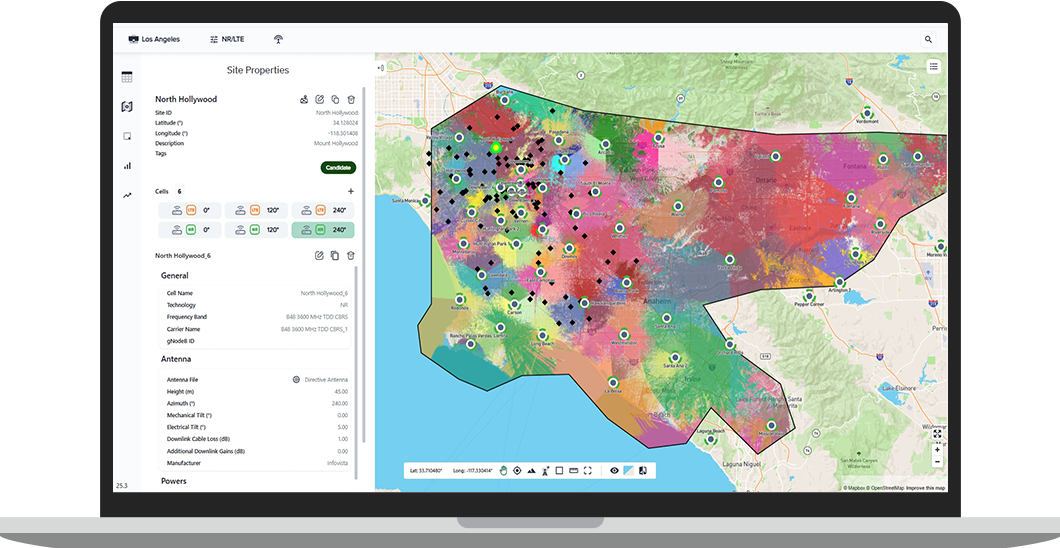
This shift toward AI-driven RF planning is already being implemented in modern RAN planning solutions. Platforms such as Infovista’s VistaPlan portfolio combine machine learning-based propagation modeling, high-resolution geodata and cloud-native simulation to bring these capabilities into day-to-day planning workflows.
Why traditional approaches can’t provide the accuracy 5G planning needs
5G networks introduce a level of diversity and complexity that legacy RF planning methods were never designed to handle.
- Multiple frequency bands (sub-1 GHz to mmWave) – Each band behaves differently. Low-band supports coverage, mid-band drives capacity, and mmWave requires line-of-sight precision. A single propagation model or calibration approach can’t accurately capture all of them.
- Multi-layer networks (macro, small cells, indoor) – Planning is no longer limited to macro sites. Dense urban deployments, indoor systems, and small cells must be designed together, with interactions between layers that are difficult to model using traditional approaches.
- New use cases (FWA, private 5G, IoT) – Networks are now expected to support very different requirements, from fixed wireless broadband to industrial automation. Each use case introduces specific coverage, capacity, and reliability constraints that need to be planned upfront.
- Higher SLA expectations from enterprises – Enterprise customers expect predictable, guaranteed performance. This leaves little room for approximation — planning outputs must closely match real-world performance from day one.
- Faster rollout cycles with less tolerance for error – Planning teams are under pressure to deliver designs faster while reducing rework. Iterative, manual calibration workflows slow down deployment and increase the risk of costly corrections after rollout.
How AI-driven RAN planning changes day-to-day operations vs traditional approaches
From a practitioner’s perspective, AI-driven accuracy shows up in four very tangible ways.
- Macro and densification decisions get sharper. With more trustworthy RSRP and SINR predictions, we can right-size designs for dense urban areas without falling back on “just in case” overbuild. That typically means fewer small cells, fewer awkward rooftop negotiations and a cleaner business case.
- Private and campus networks become less of a gamble. When you walk into an industrial customer’s boardroom and commit to an SLA, you want to know your design really will deliver on day one – not after three optimization cycles. AI-trained models, especially when combined with good 3D data, give you the confidence to offer deterministic guarantees.
- We reduce dependency on a handful of highly skilled but finite pool of experts. In many teams, the best calibrators are a scarce resource and a single point of failure. When knowledge is embedded in the model and its training process, rather than locked in people’s heads or bespoke spreadsheets, it scales globally.
- Engineering time shifts from tuning to exploring. If the first prediction is much closer to reality, you spend less time fighting the model and more time exploring alternative scenarios: different antenna options, vendor mixes or spectrum strategies for the same budget.
Delivering these benefits consistently requires more than isolated tools. It requires an integrated planning environment where RF design, propagation modeling and geodata are unified. Solutions such as VistaPlan bring these elements together, enabling planning teams to move from manual, fragmented workflows to a consistent, data-driven approach.
How to rightly measure RF planning accuracy for 5G networks
But none of this matters if we can’t prove it. 5G RF planning accuracy depends on how reliably planning outputs translate into real network performance and support deployment decisions.
Key 5G RF planning KPIs for the highest accuracy should include:
- RSRP and SINR prediction error – They show how accurately the model reflects real signal behavior. Even small improvements here can translate into better spectral efficiency and fewer required sites.
- Time to calibrate new frequency bands – It becomes critical, as faster calibration directly impacts rollout speed and the ability to support new use cases.
- Site count variance between design and rollout – Large gaps signal unreliable planning assumptions, often leading to rework and additional CAPEX. Reducing this variance means designs are right the first time.
- Field test volume and cost – They should decrease as model accuracy improves, reflecting greater confidence in planning outputs and less reliance on post-deployment validation.
- Alignment between planned and actual performance – When predicted coverage and capacity match what is delivered in the field, it validates both the model and the planning process.
Taken together, these KPIs shift RF planning from a technical exercise to a measurable function tied directly to cost, speed, and network performance.
AI-driven planning accuracy won’t replace RF engineers. But it will change what “good RF engineering” looks like: less manual calibration, more scenario design; fewer arguments about whose model is “right,” and more focus on how best to monetize the spectrum and sites you already have.
If you want to explore how leading operators are improving RF planning accuracy for modern networks — from AI-driven models to cloud-native workflows — the full framework is detailed in our RAN Planning Best Practice eBook.
You can also explore how these capabilities are applied in practice through solutions such as VistaPlan, Infovista’s portfolio for AI-driven network planning and investment optimization.
