


Many have attended enough editions of Mobile World Congress to know how the cycle works; a new technology emerges, the first year, it’s a concept, the second year, it’s a keynote, the third year, it’s a booth demo. And eventually, if it’s real, it becomes something people stop talking about and start using.
MWC Barcelona 2026 felt like that turning point for AI in telecom.
Walking the halls of MWC, you couldn’t miss it: agentic AI was everywhere. Not (only) as a buzzword pinned to a slide deck, but as a working assumption embedded into product announcements, operator strategies, and partnership launches. Qualcomm’s CEO called 2026 “the year of agents.” Huawei declared the arrival of the “agentic Internet era.” McKinsey framed it as a shift from experimentation to impact, noting that leading operators are now achieving measurable returns by embedding AI into core operations, not just running isolated pilots.
The consensus was clear:
The question is no longer whether AI belongs in telecom.
It’s whether your AI actually knows telecom.
The real divide at MWC26
Beneath the surface of the AI conversation at MWC26, a more interesting divide was taking shape. On one side, companies that had adopted general-purpose AI tools and were layering them onto existing operations. On the other, companies building intelligence from the ground up, rooted in domain expertise, network data, and operational context.
This distinction mattered because the operators we spoke with at our booth weren’t asking “Do you have AI?” They were mainly asking, “Does your AI understand my network?” and “Can it actually do something more than show me a dashboard?”
What we brought to Barcelona
For Infovista, MWC26 marked the public unveiling of VistaOne, our unified platform that brings together everything we do: network planning, testing, assurance, and customer experience intelligence under a single, AI-powered architecture. It’s the result of 30 years of building network and enterprise CX intelligence. And it represents a significant step for us as a company.
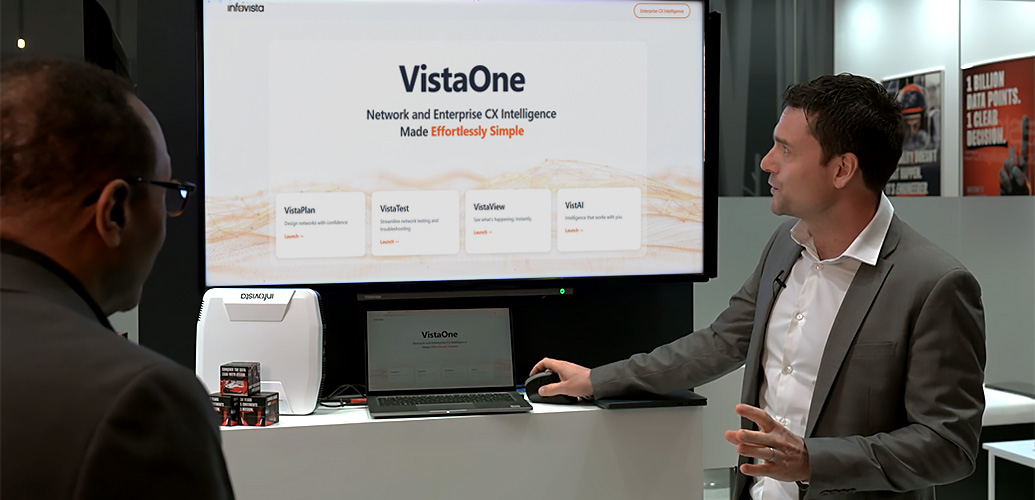
VistaOne addresses two complementary domains. True Network Intelligence provides end-to-end visibility and insights across the network lifecycle for communication service providers and enterprises, from investment planning and infrastructure design to transformation validation and ongoing assurance to monetization. Enterprise CX Intelligence delivers insights across the customer journey for enterprises, contact centers, and service providers, helping organizations model, validate, and monitor the experiences they deliver.
These aren’t separate product lines. They’re two expressions of the same underlying reality:
Network performance and customer experience are inseparable.
VistaOne treats them that way.
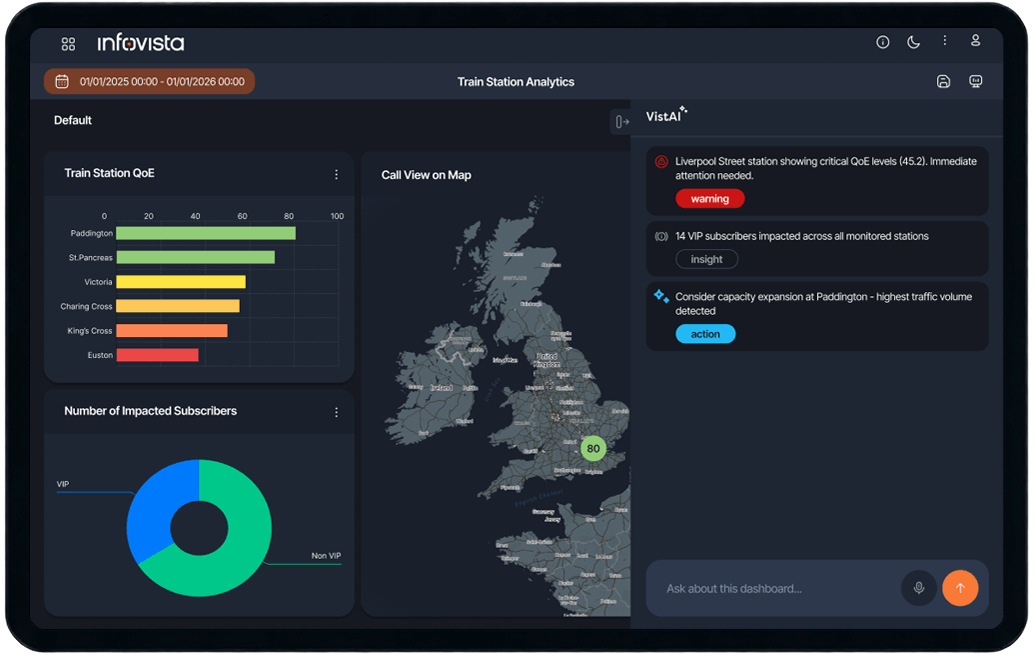
Powering it all is VistAI™, our agentic AI framework that we launched in January 2026. VistAI is designed around three profiles: Ask, Automate, and Monetize and operates through approximately 90 intent-based AI agents that can query network data in natural language, trigger closed-loop automation workflows, and help operators turn experience intelligence into revenue. As TelecomTV reported from MWC, the launch of VistAI positions Infovista at the intersection of the agentic AI trend that dominated the show floor.
What MWC26 told us about where the industry is heading
Every MWC has its share of noise. But this year, a few themes cut through consistently, across keynotes, booth conversations, and operator briefings. Here’s what stood out to me and how it connects to the work we’re doing.
The bottleneck isn’t agents. It’s data.
Agentic AI was the headline, but the more honest conversation happening behind it was about readiness. GSMA Intelligence put it plainly before the show: building an AI-ready data foundation remains the single biggest challenge for operators, who are still dealing with years of siloed, legacy systems. Operators have invested heavily in data lakes, but much of that data still isn’t accessible, consistent, or usable by AI systems.
Microsoft echoed this at MWC with its “unified data fabric” pitch, built on Azure Fabric and positioned as the middleware layer that collapses OSS/BSS silos so agents and analytics workloads can actually reach the data they need. Nokia showed how integrating its data suite with Fabric can reduce AI use case development time by up to 80%.
The takeaway is this: agentic AI in telecom doesn’t need more agent fabric. It needs proper data fabric. Agents are only as smart as the data they can reach and the domain models that interpret it. The companies that have spent decades curating, structuring, and understanding network data, across RF, core, transport, and customer experience, have an advantage.
This is exactly the bet we’ve made with VistAI. Our AI is built on 30 years of network intelligence models and algorithms that understand what good network performance looks like. When the industry talks about telecom-native AI, this is what it means in practice.
The industry is done with AI theater.
Opensignal’s VP of Industry Analysis set the tone before MWC even started: “The industry will now be judged less on ambition and more on proof.” That message landed. Across the show floor, the conversations we had with operators were relentlessly practical. Nobody wanted a roadmap presentation. They wanted to see working products addressing everyday use cases, real metrics, and a clear path from pilot to production.
For us, this shift validated the approach we’ve taken. The results we’re seeing with customers (60% faster troubleshooting, 30% fewer alarms, 40% fewer truck rolls) aren’t benchmarks from a lab. They’re production numbers. And that’s what operators are asking for.
Selling bandwidth is over. Selling outcomes is next.
Ericsson’s MWC message was pointed: operators need to shift from selling connectivity as a pipe to selling it as a predictable, assured experience. A video call that never fails. Enterprise SLAs that actually mean something. Monetization through network APIs and differentiated service levels, not just volume.
Deutsche Telekom reinforced this by embedding AI directly into communication services, launching a network-integrated call assistant with live translation and real-time assistance, built into the network layer rather than as an app. The message: intelligence should be native to the service, not bolted on.
This is where the convergence we’re building with VistaOne becomes relevant. When you can see both network performance and customer experience on the same platform and correlate a network event to its customer impact in real time, you’re assuring an outcome.
Our partnership with CSG is a concrete example. At MWC we showed how connecting VistAI and VistaView with CSG Converged Mediation & Activation enables operators to detect experience issues before customers feel them, and trigger context-aware retention and monetization actions in the moment. As RCR Wireless covered in their MWC report, this kind of integration is where the real value lies: not AI as a concept, but AI that connects to business outcomes.
AI-native is becoming the architectural default.
At MWC, Nvidia secured commitments from over a dozen operators and vendors (BT Group, Deutsche Telekom, Ericsson, Nokia, SK Telecom, SoftBank, T-Mobile, Cisco) to build 6G on open, AI-native, software-defined platforms. SK Telecom’s CEO outlined a full-stack AI-native rebuild, from core to customer service, including plans to scale its sovereign AI model to over one trillion parameters.
SoftBank demonstrated its Autonomous Agentic AI-RAN system, while Huawei launched its Autonomous Network L4 Phase 2 in presence of China Mobile, Deutsche Telekom, Telefónica, and Orange, who discussed how the large-scale commercial adoption of autonomous networks will inject new momentum into intelligent transformation across the industry.
What this means for companies like ours:
The networks of tomorrow will be designed around AI from day one.
The intelligence that plans, tests, and assures those networks needs to keep pace. We’re not pretending that products built over three decades were born AI-native. They carry something no startup can replicate: deep domain expertise encoded into models, algorithms, and data structures across the full network lifecycle.
VistaOne is the platform that unifies these proven capabilities (VistaPlan for planning, VistaTest for testing, VistaView for assurance, VistaCX for customer experience) under a single AI-powered platform, with VistAI as the intelligence layer that makes them work together. That’s our path to an AI-native future: not by starting over, but by connecting 30 years of depth to a modern, unified architecture.
Sustainability moved from ESG report to engineering spec.
A quieter but persistent theme at MWC26: energy efficiency is no longer a corporate responsibility talking point. It’s an engineering requirement. Intel emphasized performance per watt as the metric operators care about most. AI-RAN deployments are being evaluated not just on throughput but on power consumption. Operators are under real pressure to reduce emissions while scaling more complex networks.
Our partnership with Nokia is a case in point. Over 56% of Nokia’s 250+ million annual field performance validations now rely on Infovista’s VistaTest solutions. By automating testing and introducing AI-powered root-cause analysis, we’ve helped reduce repeat drive tests by 28%: fewer vehicles on the road, lower fuel consumption, reduced CO₂ emissions. At MWC, we showed where this is heading: drone-based testing, rover-based validation, and the robot dog on Nokia’s stand that uses Infovista technology. Autonomous field validation now materializes.
What I’m taking away from MWC26
Three things stand out as I reflect on the week.
First, data is the moat. As general-purpose AI becomes commoditized, the differentiator is what your AI actually knows. The companies that have spent years curating domain-specific data, and building the models and algorithms that make it useful, will outperform those that adopted AI as a layer. In our case, that’s 30 years of network intelligence across planning, testing, assurance, and customer experience.
Second, convergence is no longer aspirational. Whether it’s OSS meeting BSS, network meeting CX, or terrestrial meeting satellite, the silos are coming down. The operators who can connect what’s happening in the network to what’s happening to the customer, and act on that connection in real time, will win. That’s the bet we’ve made with VistaOne.
Third, proof beats pitch. The companies that showed up with working product and real metrics earned the most attention this year. The ones that showed up with roadmaps and buzzwords didn’t. That shift is permanent, and it’s healthy.
We came to Barcelona to show where Infovista is going. We left knowing the industry is heading in the same direction.
If you missed us at Hall 2, Stand 2B88, there’s still time to catch up. Explore VistaOne or discover VistAI, visit us at the upcoming industry events FNW World 2026 (April 21-22) and DTW Ignite 2026 (June 23-24) and see what True Network Intelligence looks like in practice.
