


Ask any RAN planning team to sketch their propagation setup and you’ll often get the same picture: a patchwork of models and tools built up over years; institutionalized knowledge; an innate understanding of what makes their network different and special.
In reality, this means one calibrated model for low-band macro. Another for mid-band. A separate configuration for dense urban high-band. And then an ever-growing pile of spreadsheets and CAD overlays for “specials” – private networks, FWA sectors or proof-of-concepts.
In traditional RAN planning, this approach worked.. But in 5G networks, it creates fragmentation, slows down planning, and reduces confidence in prediction accuracy.
Why are traditional RF propagation models less effective in 5G networks
Modern RANs are deliberately heterogeneous. 5G networks must support:
- New mid-band macro layers for urban coverage and capacity
- mmWave hotspots in stadiums and transport hubs
- FWA overlays for suburban broadband
- Sub-1 GHz coverage layers for reach and resilience
- Private 5G networks across ports, factories and campuses
- RedCap and mid-tier IoT devices with very specific mobility and power characteristics
Each environment follows different propagation physics: diffraction and clutter for mid-band, strict line-of-sight and high attenuation for mmWave, fast-changing clutter in urbanizing areas.
If your propagation architecture responds to that complexity by adding more separate models, you end up with more calibration work, more room for misalignment between teams, more difficulty comparing scenarios across markets and use-cases – and ultimately more time wasted trying to decide whose prediction, if anyone’s, is “correct”.
At executive level, that erodes confidence. When finance or an enterprise customer asks, “How do you know this design will perform as promised?”, the last thing you want is three different answers from three different tools.
What factors influence propagation model accuracy?
Several factors directly affect how accurately propagation models predict real-world performance:
- Frequency band and spectrum characteristics
- Quality and resolution of geodata
- Environmental complexity (urban, suburban, indoor)
- Calibration methodology and data inputs
- Ability to incorporate real-world measurement data
The pillars of an advanced RF propagation framework
The alternative is to treat propagation not as a collection of models, but as a unified modeling framework that can support every band, morphology and use-case.
We break that down into four pillars, which are explained in depth in our eBook RAN Planning Best Practice:
- Native 3D modeling – Enrich representations of terrain, buildings, rooftops, bridges, tree canopies and foliage. This is non-negotiable for C-band and mmWave, where line-of-sight and multipath are everything
- API-enabled scalability – Offloading large-area or repetitive simulations to elastic cloud infrastructure, so national-scale or multi-scenario studies become routine
- Multi-use-case versatility – The same propagation framework serving macro, small cell, indoor, FWA, private/campus and RedCap IoT
- Consistent data model and governance – A shared baseline for geodata and parameters so that teams and regions are genuinely comparing like-for-like
When you get these pillars in place, you start to see propagation in a different light: not as a bottleneck but as a shared service that everyone, from RF to enterprise sales, can consume.
The value of cloud-based propagation services and democratized RF planning
One of the most interesting developments here is the rise of cloud-based propagation APIs backed by curated geodata, an area where Infovista is leading the way via its partnership with Google Cloud.
Instead of every operator sourcing, cleaning and maintaining their own terrain and clutter datasets and then spending weeks calibrating models from scratch, network planning teams now can leverage:
- Pre-calibrated propagation models, trained on large-scale measurement datasets
- Global geodata that is continuously updated (terrain, buildings, vegetation)
- Cloud-hosted services that can be turned on as a subscription or even project-by-project
In practical terms, this means that:
- Smaller or more resource-constrained organizations, including regional operators, services companies and enterprises planning private 5G, can access RF planning accuracy that used to require a large in-house RF team. Using pre-calibrated, pre-tuned geospatial data such as Google Cloud’s Propagation API democratizes advanced modeling.
- Larger operators get a shared propagation baseline for all planning teams, whether they’re working on macro densification, a new campus RFP or a FWA trial.
What are the best tools to modernize RF propagation modeling?
Modern RF propagation modeling requires more than standalone tools. Leading solutions combine:
- AI-based propagation modeling
- High-resolution 3D geodata
- Cloud-native simulation capabilities
- Support for multiple use cases (macro, indoor, private 5G, FWA)
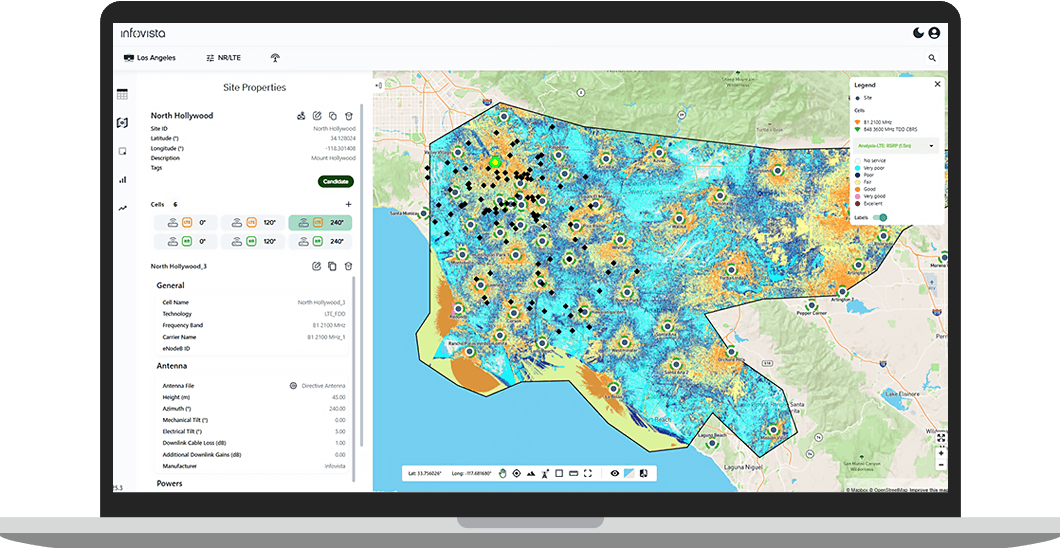
Infovista’s VistaPlan integrates these capabilities into a unified planning environment, enabling faster, more consistent, and more accurate network design.
KPIs to measure the performance of modern propagation models
Modern propagation models should not only improve accuracy, but also increase planning efficiency and consistency across teams. If you’re thinking of evolving your propagation architecture, a few KPIs are particularly telling:
- Simulation speed and throughput – how long does it take to produce a robust, validated scenario, and how many can you run in parallel?
- Scenario reuse rate – how often can templates and calibrated models be reused across markets and projects?
- Cross-market consistency – how much do model errors or assumptions diverge between regions or teams?
- Cloud efficiency and cost – what is your cost per completed simulation when you use cloud resources vs local?
These speak to how ready your organization is to support new spectrum, new services and new business models without rewriting the RF planning playbook each time.
In 5G networks, propagation modeling directly impacts planning speed, investment decisions, and network performance.
From patchwork to planning fabric: a practical evolution path
Most of us won’t throw away our existing models overnight. Nor should we. But we can start to layer a more advanced propagation framework alongside them: introduce native 3D and cloud-scale simulation for new 5G and private network work; standardize templates for common use-cases; move gradually from bespoke calibrations to shared, learning-based models.
If you want to understand how leading operators are modernizing propagation modeling, from fragmented workflows to unified frameworks, the full approach is detailed in our RAN Planning Best Practice eBook.
You can also explore how these capabilities are implemented in practice through VistaPlan, Infovista’s AI-driven network planning solution, by booking a demo with our team.
